This article explains when travelers in Guangzhou need a private car with driver instead of relying on the subway or taxis, especially for hot weather, transfers, luggage, and multi-stop days.
Based on local expertise, this guide explains when hiring a private car in Guangzhou is more practical than using the subway or taxis. It offers practical tips from experienced guides on humidity, crowded lines, walking distances, and how multi-stop itineraries can disrupt a day.
If you're planning a trip to Guangzhou to see the Canton Tower and enjoy a night cruise on the Pearl River, you've probably already studied the Guangzhou subway map and found it incredibly extensive; you might have even downloaded Didi Chuxing (a ride-hailing app) and feel confident in your abilities. Frankly, if your itinerary is simple—alone, with a backpack, staying in the city center, and only visiting one or two places directly accessible by subway each day—then you don't need a private car at all; Guangzhou's well-developed public transportation is more than adequate.
However, Guangzhou has a knack for turning a seemingly relaxing day into a fragmented and exhausting one. The problem isn't how "hardcore" the city is, but rather the combination of distance, humidity, traffic pace, and the overwhelming number of things that can't be done in one go. This is where the value of a private car with a driver becomes apparent.
Understanding the daily challenges Guangzhou presents to tourists
Before deciding to hire a car, we need to understand the real-world issues you might encounter as a tourist from out of town or abroad when using local public transportation or taking a taxi. These issues may seem minor individually, but they can accumulate and ruin your good mood.
Subway: Efficient, but very energy-consuming.
Crowding and High Temperatures: Even during off-peak hours, Lines 3 and 5 are often packed with people. In Guangzhou during the summer, the ground temperature exceeds 35°C, and the humidity is high. Dragging your luggage through the subway station for 10 minutes to transfer, your clothes will be soaked with sweat before you even board the train.
Discontinuous Journey: The subway takes you from point A to point B, but what happens after you exit the station? Getting from the subway station to your destination might involve 10-15 minutes of walking through a maze of underground passages. If you're going to a wholesale market or a hidden restaurant, you often face another hot and chaotic walk after getting off the subway.
Ride-hailing/Taxi: Promising to be convenient, but full of uncertainties
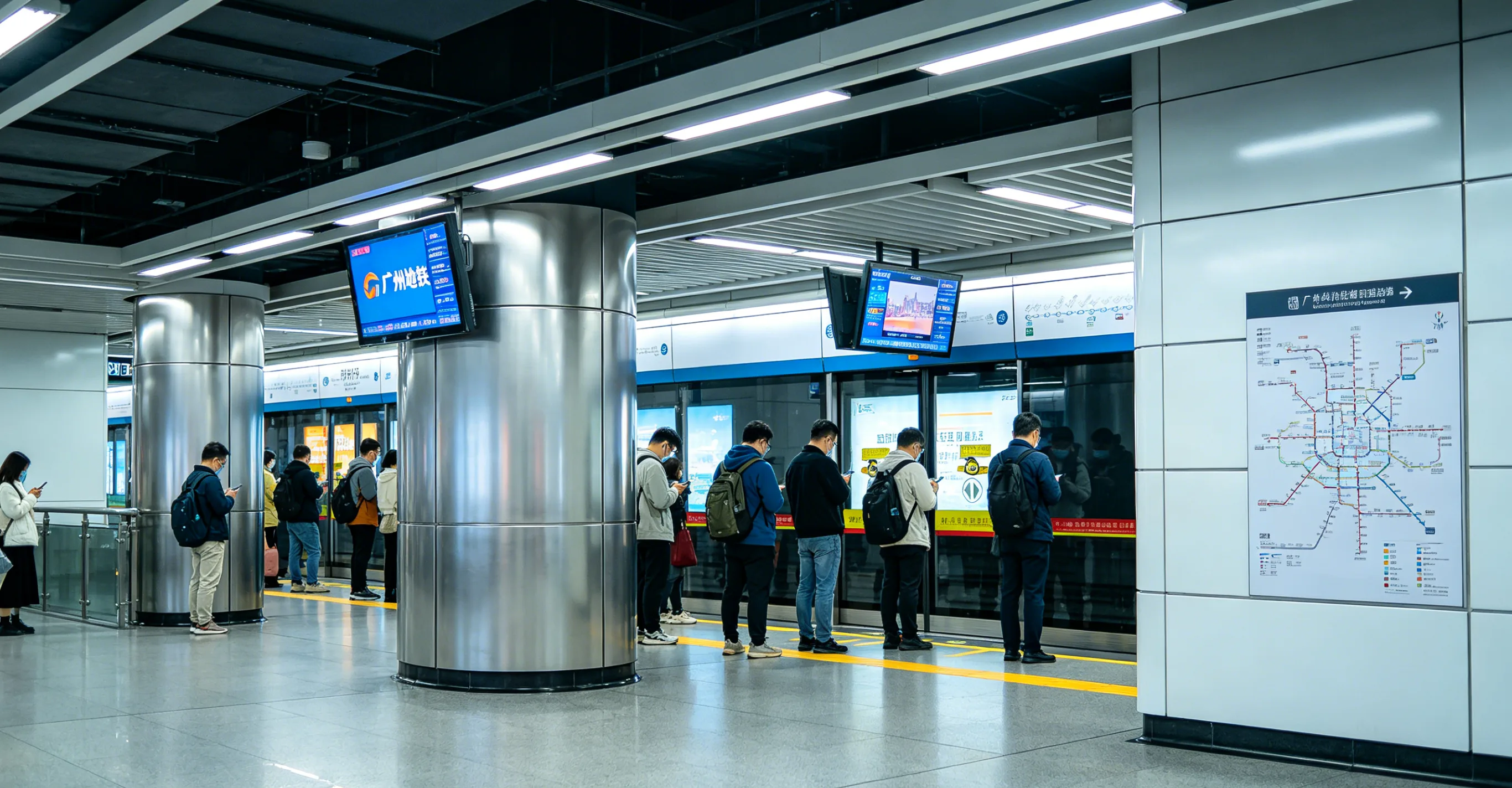
A Nightmare of Location and Communication: You call a car using the international version of Didi, but the driver speaks almost no English. He sees your approximate location in the app and immediately calls you, speaking a string of Chinese, perhaps to confirm "which side of the road" you're on, or to tell you "you can't stop here, walk 200 meters forward." You can't understand him, he can't find you, and the order is canceled. This situation is especially common at airports, train stations, and exits of large shopping malls.
Luggage and Passenger Limitations: The trunk of a regular taxi is full after fitting two 28-inch suitcases. If you're a family of four plus a stroller, you'll likely need to call two taxis, or you might be refused service.
Peak Hour "Unavailable": From 5:30 PM to 7 PM, in Guangzhou's core area, you'll often see "10+ people in the queue" or 1.5 times the usual price on ride-hailing apps. Standing on the sweltering street, watching the waiting icon spin on your phone, the fatigue can make you question your plans for the day.
Small Costs Not Low: Each taxi ride is a "mini-project" in itself: waiting, communication, carrying luggage, payment. Repeating this four times a day fragments your itinerary.
Public buses: They are almost never recommended for foreign tourists who are staying for a short time or have a tight schedule.
So, what exactly is private car rental?
Here, I'm not talking about renting a car and driving yourself (you need a Chinese driver's license in China, and city driving can be challenging), but rather hiring a car with a driver (usually only able to speak Chinese). You control the car, and the driver follows a pre-determined route or general plan, paid by the day or per trip.
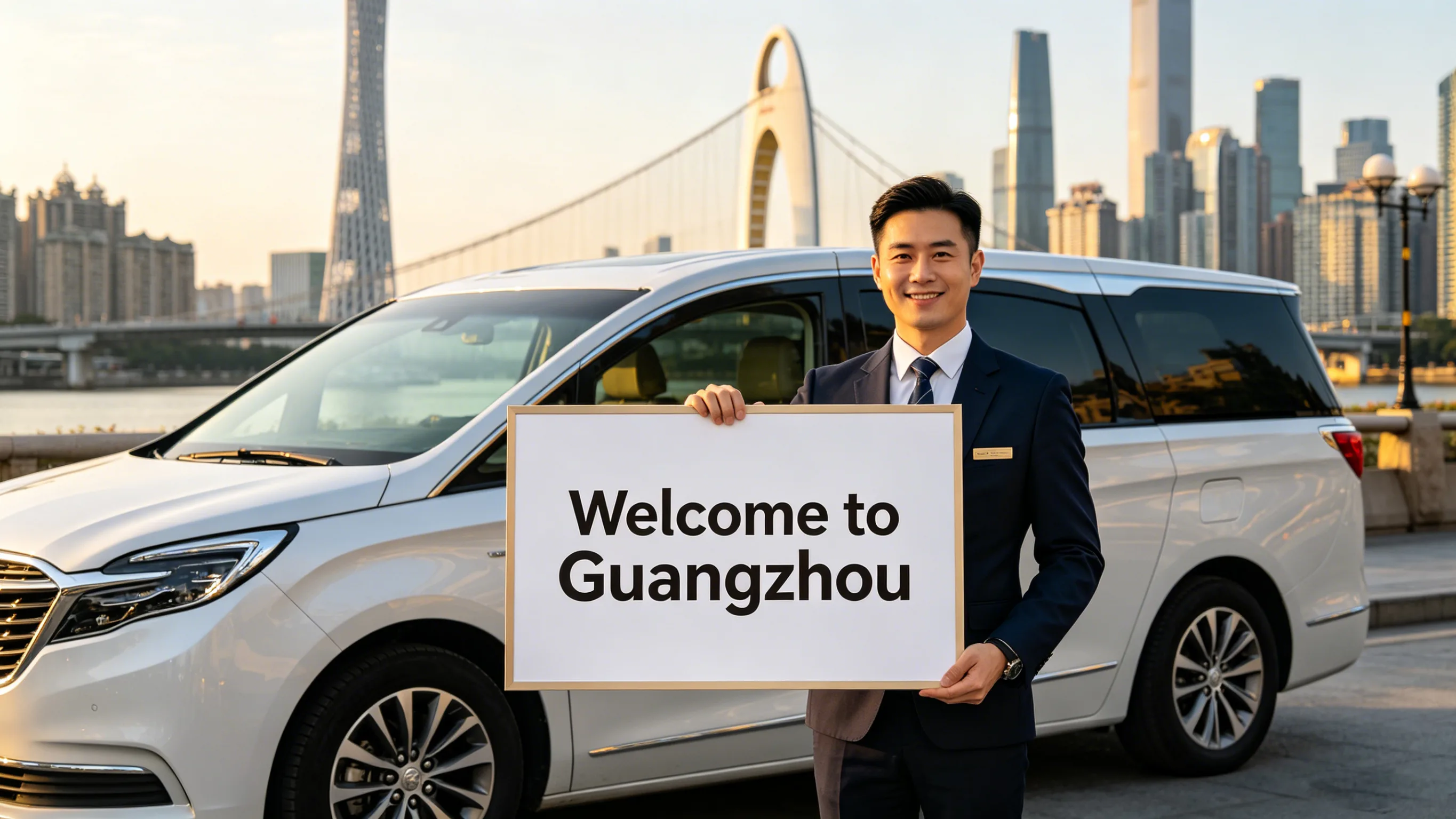
Its core value isn't luxury, but rather:
A mobile "base": Luggage, shopping items, and coats can be stored in the car indefinitely.
Continuous travel: Get in the car as soon as you leave, and you're at your destination the moment you get off—no transfers, waiting, or carrying anything.
Reduced decision-making fatigue: You don't need to replan "how to get to the next stop" at every step.
In what situations would hiring a car significantly improve your travel experience?
The core value of chartered car services isn't "luxury," but rather continuity and predictability. Below, we'll explain in detail with specific scenarios, providing a comparison of real-world time, cost, and pain points for each.
Scenario 1: Arrival day after a long flight (Airport → Hotel)
Typical Route: Baiyun International Airport → Hotel in Tianhe District (Zhujiang New Town)
Distance: Approximately 38 kilometers

Transportation Issues:
Subway: Fare is 8 yuan, but requires 1-2 transfers (Line 3 North Extension is very crowded), the entire journey takes about 65 minutes. If you have two large suitcases, transferring at some crowded subway stations can be overwhelming.
Taxi/Ride-hailing: Waiting times of up to 30 minutes are common, the metered fare is approximately 80-120 yuan, but prices increase at night and during traffic jams. The driver may not be familiar with your hotel (English address is useless).
Chartering a car:
Book your airport pick-up in advance. The driver will be waiting for you at the arrival gate with a sign, help with your luggage, and take you directly to your hotel.
Cost: Approximately 300-400 RMB (standard 5-seater sedan/minivan), about twice the price of a taxi.
Time: Less than 5 minutes from customs to boarding, journey time 45-60 minutes (depending on traffic).
Real benefits: After a 12-hour flight, the last thing you need to do is study subway maps, queue, and carry luggage. Chartering a car gives you a "brainless" option during your most tiring moments.
When it's unnecessary: When you only have a backpack, your hotel is right next to the subway station, and you don't mind standing for an hour during rush hour.
Scenario 2: Family trip (elderly and children)
Typical Route: Chen Clan Academy → Shangxiajiu Pedestrian Street → Shamian Island → Pearl River Night Cruise Pier

Public Transportation/Taxi Pain Points:
These attractions are close by subway (mostly 2-4 stops), but the time spent entering and exiting stations, security checks, going up and down stairs, waiting for the bus, and transferring at each point adds up to 20 minutes longer than the actual journey.
If you try to take a taxi in segments, you might face difficulties getting a ride or waiting for a vehicle, which is particularly frustrating in the summer.
How to improve the experience of chartering a car:
Full-day (10 hours): A standard 5-seater sedan costs approximately 800 RMB, and a 7-seater minivan costs approximately 1000 RMB (easily accommodating strollers or folding wheelchairs).
Door-to-door service: The driver waits at the attraction's exit, saving children and the elderly from walking an extra kilometer; the car takes you directly to the next attraction's parking lot, where you can drop off right away.
Recover on the way: Children can sleep, and the elderly can sit, drink water, and enjoy the air conditioning, avoiding the need to stand and squeeze onto the subway.
Flexibility: You can return to your hotel early if you get tired without having to call another car.
When do you not need a chartered car?
If you're only going to one place (e.g., only Chimelong) → A one-way round-trip taxi ride will cost approximately 160 yuan.
If the elderly/children are in good physical condition and the attractions are within walking distance or 1-2 subway stops away.
If your group includes people who cannot walk for long periods, climb stairs, or tolerate high temperatures (infants, the elderly, pregnant women, or those with minor disabilities), hiring a car for a day trip to multiple destinations is not a luxury, but a practical tool to keep everyone in a good mood. Spending an extra 600-800 yuan ensures the whole family has the energy to continue enjoying themselves the next day—many families consider this the most worthwhile expense of their Guangzhou trip.
Scenario 3: Mixed-Purpose Itinerary (Business + Sightseeing + Dining + Shopping)
Typical Route: Meeting/Exhibition → Lunch at a Cantonese restaurant near Tianhe City → Afternoon visit to the factory you wish to visit → Evening return to a hotel near Guangzhou Tower

Public Transportation Pain Points:
This is almost impossible to complete using public transportation, and it will be a huge waste of your time if you are traveling for business.
Ride-hailing (segmented fares): Prices are relatively cheap, but you'll need to wait 5-15 minutes each time you call a taxi. Even more troublesome is that if you are traveling across regions, it may be difficult to get a taxi.
Chartering a car:
Full day (10 hours): Approximately 1200-1500 RMB.
The driver is waiting for you at the hotel entrance. You've gone overtime in your meeting? No problem at all, the driver will wait.
Real Value: The most crucial aspect of this type of trip is its flexibility in timing and unrestricted destination. A taxi won't wait for you to visit that furniture showroom you want to see more of, or that farm you decide to go to on a whim, but a chartered car can.
Cost Comparison: Taking taxis in segments might also work, but it requires repeated communication, waiting, and worrying about the car not showing up. Chartering a car is about 2-3 times more expensive, but you gain complete certainty for the entire day.
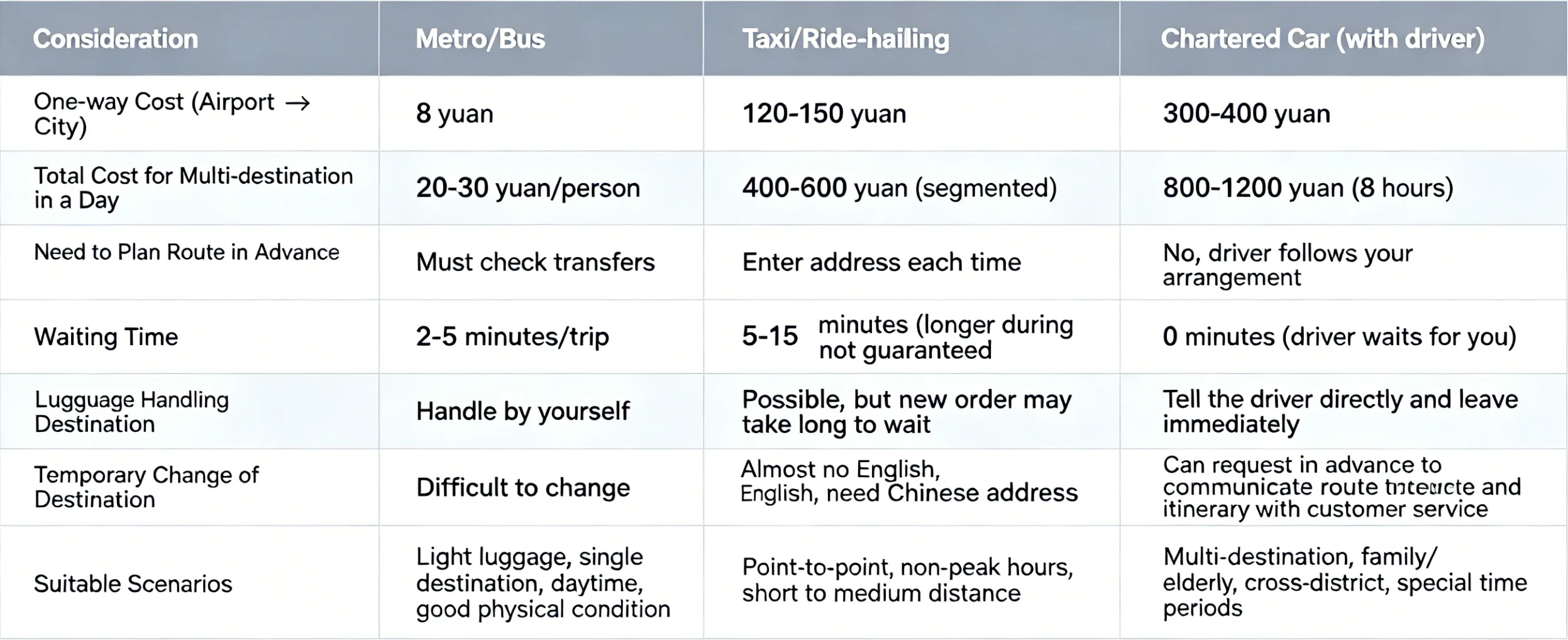
Chartering a car vs. other modes of transportation: A table to understand the differences
Practical tips for chartering a car for tourists
1. You don't need to hire a car for the entire trip; just hire one on "high-traffic" days.
For example: arrival day, departure day, days crossing more than three areas, or days with elderly people or children.
For daily trips to a single attraction within the city: taxis or the subway are perfectly sufficient.
2. Important Reminders
Child Seats: Not mandatory in China, but if you need one, be sure to emphasize "need child seat" when booking, otherwise it's unlikely to be available.
Payment: Most platforms accept foreign credit cards or PayPal. If you're dealing directly with the driver, prepare cash (RMB).
Cancellation Policy: Platform bookings usually allow free cancellation up to 24 hours in advance.
Communication: It's recommended to save the Chinese address and landmark pictures on your phone to show the driver. For example: "Guangzhou Tower → Canton Tower," but it's safer to write "Guangzhou Tower, 222 Yuejiang West Road, Haizhu District."
Congestion Times: Guangzhou Avenue, Tianhe Road, and Huangpu Avenue are extremely congested from 5-7 pm on weekdays. Hiring a car will also result in congestion, but you can rest in the car instead of standing in the subway.
3. Vehicle Selection and Luggage Capacity
5-Seater Sedan: Recommended for 3 people, maximum 4. Can accommodate 2 26-28 inch suitcases. Note: If 4 adults each bring a large suitcase (28 inches or larger), the 5-seater will not be enough; a 7-seater will be required.
7-Seater Minivan (e.g., Buick GL8): Recommended for 6 people, maximum 6. Can accommodate 4 26-28 inch suitcases.
12-Seater Minibus: Maximum 11 people. Luggage space needs to be consulted with customer service in advance.
National regulations stipulate that infants and children must be counted as one person in the total number of passengers, and they must wear seat belts or use child seats. If you have 4 adults and 2 children, a 5-seater vehicle is not enough, and you must choose a 7-seater or larger vehicle.
4.Best Time to Travel to Guangzhou
Understanding Guangzhou's weather and peak seasons is crucial to determining whether you need to hire a car for your trip.
Golden Season: October-December (Autumn, Highly Recommended)
Weather: Average temperature 18-25°C, sunny, low humidity, very few rainy days. This is the most comfortable season in Guangzhou.
Activities: Ideal for outdoor activities—hiking Baiyun Mountain, strolling along the Pearl River, and exploring Shamian and Shangxiajiu Pedestrian Streets are all very pleasant.
Avoided Periods: May-September (Summer and typhoon season, strongly discouraged)
June-August: Average temperature 27-35°C, humidity often 90%+, wind chill above 40°C. Frequent heavy rain and thunderstorms, occasional typhoons.
Real Experience: Standing outdoors for 5 minutes will soak your clothes with sweat; it's very tiring. While subway stations are air-conditioned, they are crowded and stuffy. If you must come to Guangzhou during this period, hiring a car is almost the only comfortable option—because you won't have to walk outside at all. The driver will pick you up from the underground parking lot of the attraction and put you in the car, where the air conditioning will be on the whole way.
5. In what situations would hiring a car actually make things worse?
You're only going to one place (like from your hotel to a museum), and it's very close by.
Your hotel is right above the subway station.
You're a solo backpacker who prefers flexibility and low costs.
During rush hour (6 pm), you'll be crossing the city, and the subway is actually faster (because of the bus lanes and no traffic jams).
Your Guangzhou Trip
If you are interested in a private car tour in Guangzhou, please contact us to customize a one-day private car trip for you.
Shunde Private Tour from Guangzhou - 8 Hours
Frequently Asked Questions
When is a private car in Guangzhou worth it?
A private car is most useful when your day includes several stops, luggage, or places not directly connected by the subway. It is also a practical choice in summer, when temperatures often exceed 35°C and 10 to 15 minutes of walking between exits and destinations can be exhausting.
Is the Guangzhou subway enough for most tourists?
Yes, if you are traveling light, staying in the city center, and visiting only one or two attractions a day with direct subway access. The article notes that Guangzhou's public transportation is extensive, but transfers, crowds, and long walks can make it tiring.
What are the biggest problems with using the subway in Guangzhou?
The main issues are crowding, heat, humidity, and the physical effort of transfers. Lines 3 and 5 are often packed even outside peak hours, and a transfer or station exit can involve around 10 to 15 minutes of walking.
How does a private car help keep a Guangzhou itinerary uninterrupted?
A driver connects each stop directly, so you avoid repeated station exits, transfers, and searching for the next ride. This is especially helpful when visiting markets, restaurants, river cruise points, or other places that are not convenient to do in one continuous public transit journey.
What should I wear for getting around Guangzhou in summer?
Wear light, breathable clothing because Guangzhou is hot and humid in summer. The article highlights that ground temperatures can exceed 35°C, so comfortable shoes and clothes that handle sweat well are important if you plan to walk or use the subway.
More to Read




Plan Your Trip
Let us design your perfect China journey
Our trip designers respond within 24 hours with a personalized itinerary and quote.