This article explains when a Chengdu private car is actually useful, comparing real costs, travel times, and practical scenarios such as airport arrivals, Panda Base visits, and Leshan day trips.
Based on local expertise and practical tips from experienced guides, this article explains when hiring a private car in Chengdu is necessary versus when metro or ride-hailing is enough. It covers real road conditions, transfer times, airport routes, Panda Base access, and typical 2026 market prices.
If you're reading this guide hoping for a more comfortable way to travel, then you probably don't need to hire a car. For most tourists exploring Chengdu, the subway and ride-hailing services are perfectly adequate—cheap, convenient, and widely available. There's almost no reason to spend hundreds of yuan more on a private car. However, if you're planning an early morning visit to the Panda Base followed by another attraction in the afternoon, a day trip to Leshan, traveling with elderly people or children and not wanting to shuttle between stations, or landing at the airport late at night with three suitcases—in these cases, hiring a car isn't about comfort, but about whether you can successfully complete your journey.
This guide is for travelers who genuinely encounter transportation difficulties. Here you'll find only real road conditions, real times, real costs, and the pitfalls you need to know in advance.
Let's do the math: How much more expensive is a chartered car compared to public transportation?
Before deciding whether to hire a car, it's best to understand the actual cost difference between hiring a car and public transportation. The comparison below is based on common vehicle types (5-seater sedans or 7-seater minivans), and the price ranges reference standard pricing in the Chengdu market in 2026.
Tianfu Airport → Chunxi Road: You can take Metro Line 18 (approximately 50-60 minutes, 10 RMB) or the airport bus (15 RMB), Car rental costs approximately 150-200 RMB (for sedans).
Shuangliu Airport → Chunxi Road: Take Metro Line 10 and transfer to Line 3 (about 50 minutes, 5-6 yuan). The average transportation cost is 5-6 yuan per person; the cost of chartering a car may be 100-150 yuan.
Chunxi Road → Panda Base: Take Metro Line 3 to Panda Avenue Station and then transfer to a bus (approximately 50 minutes, 7 yuan). Chartering a car may cost 500-600 yuan (this price includes taking you to other attractions).
Chengdu → Leshan/Dujiangyan (One-Day Tour): Let's compare it using Leshan as an example. High-speed rail (approx. 1 hour, 51-54 RMB/person, second-class seat) + transportation from Leshan Station to the scenic area, public transportation approximately 80-100 RMB/person (round trip); total cost of chartered car approximately 500-800 RMB.
Half a day (4 hours) in the city: If you take the subway, it may cost 10-20 yuan; a taxi may cost around 50 yuan; a chartered car will cost approximately 300-400 yuan.
Half a day (8 hours) in the city: If you take the subway, it may cost 30-40 yuan; a taxi may cost around 60 yuan or more; a chartered car may cost around 500-800 yuan.
For solo or couples: Chartering a car typically costs 2-5 times more than public transportation, making it economically unfeasible.
For small groups of 3-4 people: After dividing the cost of chartering by the number of people, the difference between chartering and public transportation becomes significantly smaller. For example, a day trip to Leshan costs about 80-100 yuan per person for round-trip high-speed rail and local transportation, totaling 320-400 yuan for four people. Chartering a car, on the other hand, costs 500-800 yuan – only 125-200 yuan per person. The difference isn't that large, but the added convenience of "one car for the entire trip, no transfers, and no need to rush for the high-speed rail" is significant.
For groups of 5 or more or with large luggage: The cost-effectiveness of chartering a car becomes apparent – while the per-person cost of public transportation remains low, the hassle of transfers and waiting time increase exponentially, making the time and effort saved by chartering a car far more worthwhile.
Chartering a car involves much more than just the fare and fuel. Toll fees, parking fees, driver's meal allowance, overtime fees, and extra mileage fees—these can add up to a final bill that's 30%-50% higher than the initial quote. I'll discuss these hidden costs in detail later.
Comparison of commonly used chartered car routes in Chengdu
Route 1: Airport/Train Station Pickup and Drop-off – Worth the expense when landing late at night or having a lot of luggage.
Shuangliu International Airport:
It's closer to the city center. A taxi ride to the city center (e.g., Chunxi Road) is about 20 kilometers, costing approximately 50-60 yuan and taking about 30-40 minutes. Taking Metro Line 10 and transferring to Line 3 to Chunxi Road takes about 50 minutes and costs 5-6 yuan. Although there's a significant price difference between chartering a car and taking the metro (50 yuan vs. 5 yuan), taxis at Shuangliu Airport are inexpensive, so there's no need to book in advance. After landing, you can use Didi Chuxing (a ride-hailing app) at the airport; you can get a car in 5-10 minutes for 50-60 yuan, only half the price of a pre-booked car (usually starting at 100 yuan).
Tianfu International Airport:
Tianfu Airport is approximately 50-60 kilometers from the city center. A taxi ride costs about 80-100 yuan and takes about 50-60 minutes. Metro Line 18 takes about 50-60 minutes to reach the South Railway Station, costing 10 yuan. Airport shuttle buses also operate at night, costing 15-25 yuan.
In what situations is it worthwhile to hire a car at the airport?
Arriving late at night: After the subway closes (the last train on Line 18 is around 11:30 PM), the airport shuttle bus, although still operating, has infrequent service, and waiting with luggage is exhausting. Chartering a car directly from the terminal to the hotel avoids all transfers.
Traveling with elderly people or children after a long flight: After flying for over ten hours, transferring to the subway or bus for another hour is too tiring for the elderly or children. Getting them directly to the hotel to rest is worth the money.
Groups or those with a lot of luggage: For four people and four large suitcases, two taxis are needed (approximately 300-400 RMB). Booking a 7-seater van in advance (approximately 350-450 RMB) is more cost-effective.
Pitfalls to be aware of in advance: Tianfu Airport is very large. It takes about 10-15 minutes to walk between Terminal 1 and Terminal 2. It is a common problem that drivers cannot find passengers or passengers cannot find the pick-up point. Be sure to confirm the specific terminal and exit number with the driver when booking.
Route 2: Visiting multiple attractions in Chengdu city – the subway is cheap, but hiring a car allows you to visit more places in a day.
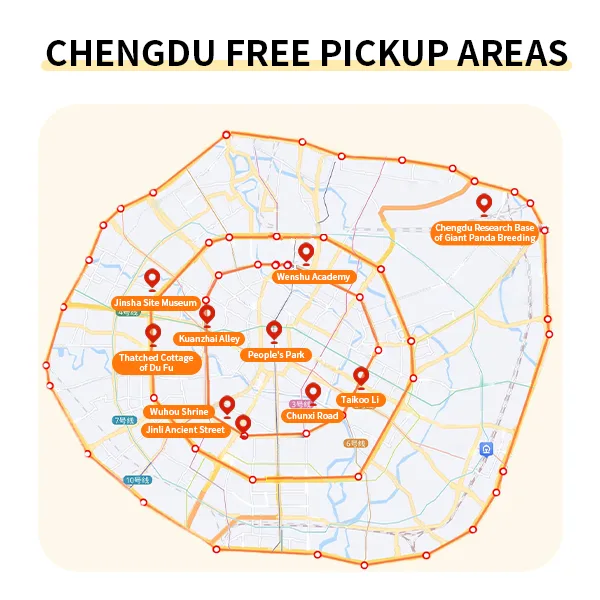
While Chengdu's attractions are relatively concentrated, visiting 3-4 places in a day (Panda Base, Jinli/Wuhou Shrine, Du Fu Thatched Cottage, Wenshu Monastery, Taikoo Li) still consumes a lot of time and energy relying on public transportation. The value of hiring a car here isn't about "not being able to go," but rather "connecting the dots more efficiently."
The actual situation of public transportation:
Chengdu's subway and bus systems are already quite friendly to foreigners—station names are in pinyin, some lines have English announcements, and you can use Alipay/WeChat QR codes (real-name authentication is required; some foreign tourists may not be able to activate this feature, so it's recommended to buy a physical Tianfu Tong card or use a single-journey ticket).
For example, consider the route "Chunxi Road → Kuanzhai Alley → Wuhou Temple/Jinli Ancient Street → Du Fu Thatched Cottage → back to Chunxi Road":
Chunxi Road → Kuanzhai Alley: Take Metro Line 2 and transfer to Line 4, or take a bus. The journey takes about 20-25 minutes and costs 2-4 yuan.
Kuanzhai Alley → Wuhou Temple/Jinli: Take a bus or transfer to Metro Line 3, the journey takes about 25-35 minutes and costs 2-4 yuan.
Wuhou Temple → Du Fu Thatched Cottage: Take bus 82 or 35 directly, the journey takes about 25 minutes and costs 3 yuan.
Du Fu Thatched Cottage → Chunxi Road: Take Metro Line 4 and transfer to Line 2. The journey takes about 30 minutes and costs 3-4 yuan.
The total cost of public transportation in a day is less than 15 yuan, but you will need to walk to the subway/bus station, wait for the bus, and transfer (about 3-5 transfers per day). In summer (Chengdu summers are hot and humid) or on rainy days, these transfers can be very tiring. More importantly, the door-to-door travel time between each attraction is about 40-60 minutes, so you can easily visit 2-3 attractions a day.
What problems can chartering a car solve in this situation?
Chartering a car (approximately 550-650 RMB for 8 hours a day, a standard 5-seater sedan) can take you directly from your hotel to the entrance of each attraction. You can simply get back in the car after your visit and leave without having to search for stations, check navigation, or worry about getting on the wrong bus. For tourists who plan to visit 3-4 attractions in a day, chartering a car can save at least 1.5-2 hours of transfer time. The car also has air conditioning, so you can rest, charge your devices, and store your souvenirs.
When is it worth hiring a car?
For a small group of 4: Public transportation costs about 60 yuan per day for four people, while a chartered car costs 400-600 yuan, an extra 85-135 yuan per person. However, the trade-off is the ease of a seamless day with no transfers, making it not expensive when split among the group.
For groups of elderly/children: Elderly people are already tired after visiting one attraction, and walking to the subway station and squeezing onto the subway will diminish their experience. A chartered car allows them to conserve their energy to see more places.
For inclement weather: Chengdu is rainy in summer and damp and cold in winter. A chartered car allows you to stay in the car all day, only getting off at attractions.
For those lacking language skills: Although the subway has English signs, asking for directions and handling emergencies (such as bus route changes) can still be challenging for foreign tourists who are not fluent in Chinese. A chartered car driver can help you buy tickets and recommend restaurants.
When is it not worth it?
If you only plan to visit 1-2 adjacent attractions (e.g., just Kuanzhai Alley and Jinli), a taxi ride one way will cost 10-20 yuan, so there's absolutely no need to hire a car for the whole day.
If you're traveling alone, have good stamina, and prefer to explore at your own pace using shared bikes and the subway.
A more economical option: Call a ride-hailing service to the first attraction (about 10-20 yuan), and then call another ride to the next attraction (10-20 yuan). Taking 3-4 rides a day will cost about 60-80 yuan in total, which is much cheaper than hiring a car for the whole day. Hiring a car is only suitable for people who "don't want to take out their phones to call a car, wait for a car, and confirm the pick-up point every time they arrive at a place."
Special note: Parking is difficult around some attractions in downtown Chengdu. Your chartered driver may ask you to get off nearby and walk a short distance, which is normal.
Route 3: Options from Chengdu to areas outside the city (Qingcheng Mountain/Dujiangyan/Emei Mountain, etc.) – High-speed rail seems fast, but the "last mile" might give you a headache.
Chengdu is surrounded by many World Heritage sites and famous mountains, but the "last mile" of public transportation varies from destination to destination. Let's compare them based on the Leshan Giant Buddha:
High-speed rail option:
Take the high-speed train from Chengdu East Station or Chengdu South Station to Leshan Station (approximately 46-60 minutes, second-class seat ticket price approximately 50-54 yuan). After exiting the station, take a taxi to the North Gate of the scenic area (approximately 20 minutes, 20-30 yuan), or take bus K1 directly (approximately 30 minutes, 2 yuan). The entire journey from door to door takes approximately 1.5-2 hours.
Charter car option:
Direct car ride from Chengdu hotel to the entrance of Leshan Giant Buddha Scenic Area, about 1.5-2 hours (about 160 kilometers), costing about 600-700 yuan (one way, usually including highway tolls).
In conclusion, if you're not in a rush or traveling alone, then "high-speed rail + bus" is the cheapest option. However, if you plan to visit more than one attraction, or are traveling with children or elderly people, then hiring a car might be more suitable.
When is it worth hiring a car (to go to the area around Chengdu)?
Small groups (3-4 people): For a trip to Qingcheng Mountain or Emei Mountain, the average cost per person for high-speed rail + local transportation is approximately 100-150 RMB (round trip). Chartering a car costs approximately 150-250 RMB per person; the price difference is small, but it saves on transfers.
For those with large luggage: If you plan to stay overnight in Qingcheng Mountain or Emei Mountain, dragging suitcases while transferring between high-speed rail and buses is very inconvenient. Chartering a car will take you directly to your hotel.
For multi-attraction combinations: For example, if you plan to visit Dujiangyan and Qingcheng Mountain in one day, public transportation requires multiple transfers. Chartering a car allows you to visit Dujiangyan in the morning and Qingcheng Mountain in the afternoon, offering more flexibility.
Route 4: Comparison of multi-day tours in Chengdu – chartered car vs. high-speed rail + local transportation, which is more cost-effective?
The previous routes mainly discussed day trips. However, if you plan to spend 2-3 days around Chengdu (such as Emei Mountain + Leshan, or Dujiangyan + Qingcheng Mountain + Panda Valley), the experience and cost will differ greatly depending on whether you choose "hiring a car to accompany you throughout the trip" or "high-speed rail + local public transportation + changing accommodations yourself".
This section uses the "Emei Mountain + Leshan" two-day, one-night trip as an example (the most classic multi-day combination) to compare two options.
Option A: Charter a car for the entire trip (2 days, same car, driver accompanies you)
Estimated Cost (for a standard 5-seater sedan, including all highway tolls, fuel, and driver's food and accommodation allowance):
2-day charter: Approximately 1400-1600 RMB (varies depending on peak and off-peak seasons)
Driver's accommodation: Usually provided by the charter company or included in the quote; you do not need to pay extra.
Your accommodation, entrance fees, shuttle bus to scenic areas, and cable car: Calculated separately.
Advantages:
Luggage can be kept in the car throughout the trip; no need to carry it between the high-speed rail station, taxis, and hotels.
Completely flexible time: You can explore Leshan for as long as you like, and even if you come down from Emei Mountain late, the car will be waiting at the entrance.
No need to research high-speed rail timetables or hail a ride-hailing service in unfamiliar cities.
Suitable for those with large suitcases, elderly people, children, or those who don't want to plan their transportation.
Disadvantages:
Expensive. A two-day car rental is generally 2-3 times the cost of the high-speed rail option.
For Emei Mountain, the car rental only takes you to the foot of the mountain (Huangwan/Baoguo Temple); you still need to take the scenic area bus to get up the mountain. The car cannot drive directly to the Golden Summit.
Option B: High-speed rail + local public transportation (self-guided)
Estimated cost (2 people): High-speed rail: Chengdu ↔ Leshan might cost around 220 RMB (if Leshan → Emeishan, the high-speed rail will cost 20 RMB); local taxi fare is around 100 RMB; then there's the scenic area bus + cable car + accommodation; the above does not include Chengdu city subway fare or meals. The total cost isn't much lower than hiring a car for 2 people (1200-1500 RMB), but the experience is more tiring.
Advantages:
Slightly cheaper (the difference isn't significant for two people, but it's much cheaper for one person).
You can experience local public transportation, which can be enjoyable for some travelers.
Disadvantages:
Multiple transfers: You'll need to transfer at least 10 times over two days, using the subway, high-speed rail, taxis, scenic area buses, and cable cars.
Luggage is a major issue: On the first day, you'll arrive at Leshan Station, need to take your luggage to the Giant Buddha (store it or carry it yourself), then go to Emeishan Station, and then find a hotel.
Timing is crucial: Missing a high-speed train could mean waiting an hour, and the last bus down Emeishan is around 5 PM; missing it will be a hassle.
Language and payment challenges: Taxi drivers in smaller cities may not speak English, and some public transportation doesn't accept foreign credit cards.
When is it worthwhile to hire a car for the entire trip (for multiple days)?
For small groups of 4 or more: Chartering a car for 2 days costs about 1400-1600 yuan, or 300-375 yuan per person; in return, you can enjoy the entire trip without changing cars, without dragging luggage, and without rushing, which is very cost-effective.
Bringing large luggage (e.g., a 28-inch suitcase + backpack): Changing cities in two days, dragging your suitcase to catch high-speed trains, squeezing onto buses, and finding taxis is extremely painful. With a chartered car, you can simply throw your luggage in the vehicle.
For elderly people or children: The elderly and children cannot withstand multiple transfers and waiting times.
If you want to spend more time in one place and less time in another: For example, wanting to spend a whole day in Leshan but only halfway up Emei Mountain, a chartered car allows you to travel entirely at your own pace.
When is it better to combine high-speed rail with independent travel?
Solo travel: A two-day chartered car for one person costs 1200-1500 yuan, while a combination of high-speed rail and independent travel costs only about 600-800 yuan, a difference of more than double. The money saved can be used to stay in a better hotel.
Light backpacker: With just a backpack, transfers are less tiring.
You enjoy train travel and planning routes: For some, taking the high-speed rail, transferring, and finding local snacks is the enjoyment of travel itself.
You have plenty of time and don't mind getting up early: You can take your time and don't need to rush.
Cost Breakdown: How Much Does It Cost to Charter a Car?
The approximate prices for chartered cars in Chengdu in 2026 are as follows (for reference only; actual prices may vary depending on the season, vehicle type, and route):
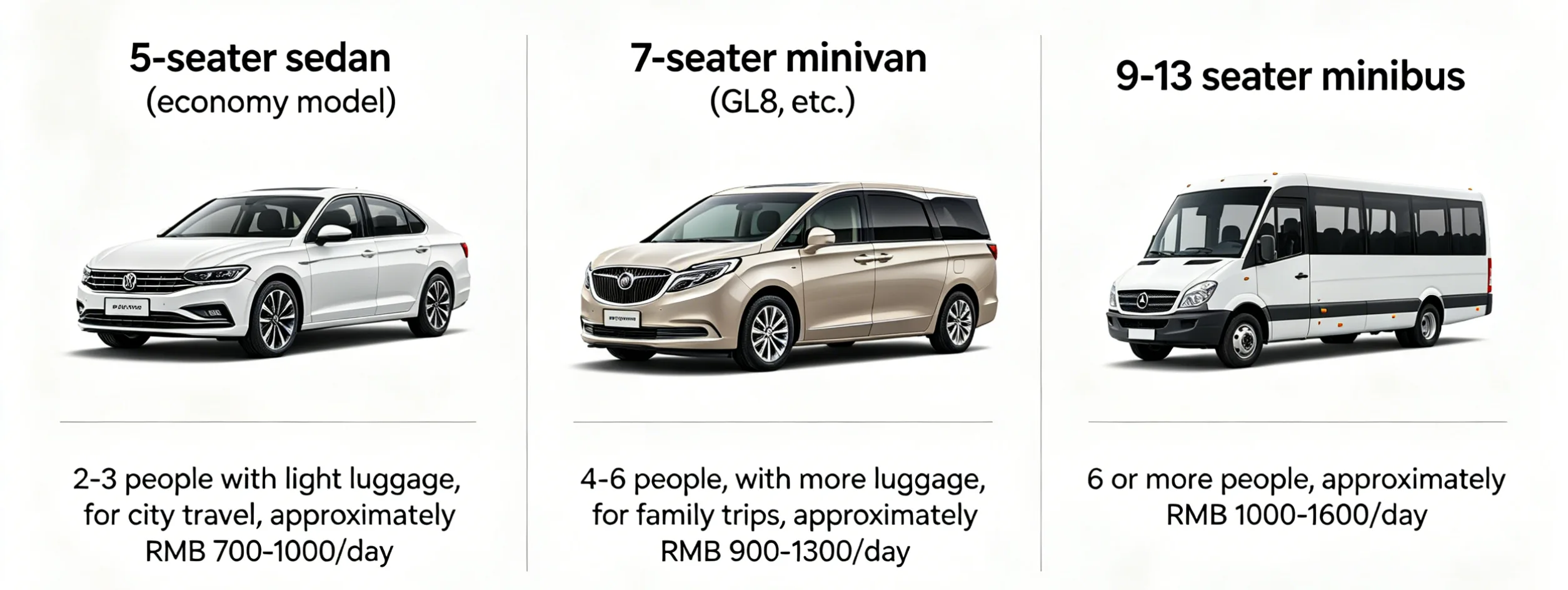
5-seater sedan (economy model): 2-3 people with light luggage, for city travel, approximately RMB 700-1000/day.
7-seater minivan (GL8, etc.): 4-6 people, with more luggage, for family trips, approximately RMB 900-1300/day.
9-13 seater minibus: 6 or more people, approximately RMB 1000-1600/day.
However, if you choose to hire a car for your trip, you should know that the price will vary depending on the route in Chengdu. For example, a day trip to the Panda Base plus other attractions might cost 600-700 yuan; if you are traveling around the Chengdu area, the price will likely be higher.
Hidden Costs That Are Easily Overlooked When Chartering a Car
If you've chosen to hire a car, then you should know that this is the most important part. Many tourists book based on the quoted price, only to end up paying 30%-50% more than the quoted price, simply because they haven't understood the following:
Toll Fees:The highway toll fee from Chengdu to Leshan is approximately50-60 yuanone way, and100-120 yuanround trip. Some quotes include toll fees, while others do not. Be sure to ask whether the toll fee is included in the quote when booking.
Parking Fees:Parking fees at scenic spots are usually not included in the quote.Parking at the Panda Base is approximately 10-20 yuan per visit, and at the Leshan Giant Buddha,it's approximately 10-20 yuan per visit. If you visit multiple attractions on a day trip, the total parking fee may be 50-80 yuan.
Driver's Meal Allowance:This is a very common "hidden" charge. Many charter companies don't mention this in their quotes, but they actually require passengers to cover the driver's lunch cost, usually 20-50 yuan per person per meal. It's common for day trips to include the driver's lunch, but it's best to confirm this when booking.
Overtime Fees:Quotes are usually based on 8 or 10 hours. Overtime is charged hourly, with a common standard being 50 yuan per hour. 5. Overtime Fee: Quotes usually have a mileage limit (e.g., 100 km/day). Beyond that, charges are calculated per kilometer, commonly 3-5 yuan/km. A round trip from Chengdu to Leshan is approximately 300 km. If the quote only includes 100 km, the extra 200 km would mean an additional 600-1000 yuan.For long-distance routes like Leshan and Dujiangyan, be sure to confirm whether the quote includes the entire mileage or only city distances.
Night Service Fee:A 20%-50% night service fee is usually added for services used between 10 PM and 6 AM the next day.
Holiday Surcharge:During May Day, National Day, Spring Festival, and summer vacation, charter prices may increase by 30%-50%, or even double. Booking in advance can lock in the price, but some platforms have "floating pricing" during holidays; carefully review the terms and conditions when booking.
Booking Channels and Methods
Domestic Mainstream Platforms:
Ctrip, Fliggy, Qunar:These OTA platforms offer a large number of car rental products. Advantages include transparent pricing, platform guarantees, and user reviews. Search for "Chengdu car rental day trip" or "Chengdu private customized car rental". Disadvantages include prices typically being 10%-20% higher than contacting local companies directly (platform commission).
KKday,Trip.com:If you prefer international platforms, these offer car rental products specifically for foreign tourists in Chengdu. They usually have English-speaking customer service, but prices are higher.
Direct Contact with Local Companies
You can directly contact travel agencies or car rental websites like RideCN, where prices may be slightly cheaper than platforms. However, when booking, be sure to choose a reputable car rental company.
10 things you must confirm before hiring a car
Before you pay, confirm the following details one by one. Don't skip items just because they "look reliable"—many disputes arise from items that seem included but aren't.
Vehicle Type and Actual Seating Capacity:A 5-seater vehicle can only seat 4 people (5 including the driver), and a 7-seater vehicle can only seat 6 people. Make sure you understand this clearly.
Luggage Capacity:A 7-seater minivan with 6 people may only fit 2-3 medium-sized suitcases in the trunk. Larger luggage requires a larger vehicle.
Who Pays Tolls:Confirm if tolls are included in the price. If not, know the toll fees for a one-way trip and a round trip.
Who Pays Parking Fees:A day trip may involve parking fees at multiple attractions; confirm if these are included.
Driver's Meal Allowance:Confirm if this is borne by the passenger. A common standard is 20-50 yuan.
Overtime Fee Calculation:How many hours are included in the price, and what is the hourly rate after that?
Mileage Limit:How many kilometers are included in the price, and what is the rate per kilometer after that?
Does the vehicle have passenger seat insurance? What is the coverage amount? It's best to purchase additional travel accident insurance.
Cancellation Policy:Is a full refund available if cancelled 24 hours or more before departure? After 48 hours? What happens if the flight is delayed, especially if it's an international flight pick-up?
Language Communication:Does the driver speak English? If not, prepare a translation app (such as Google Translate or Microsoft Translator). For those requiring English communication services, consider hiring a company that provides bilingual drivers.
Language issue: What if the driver doesn't speak English?
This is a major concern for many foreign tourists. The reality is:most drivers in Chengdu don't speak English, or speak very limited English. Don't expect them to act as tour guides or fluently communicate about complex itineraries.
Solutions:
Write down all information in advance: hotel address, attraction names, departure time, and planned route. Write this down in both Chinese and English on a piece of paper or on your phone and show it to the driver. The Chinese address is especially important—you can use Baidu Maps or Gaode Maps to find the address and show it directly to the driver.
Use translation apps: Google Translate and Microsoft Translator both support Chinese-English translation. Google Translate's "conversation mode" can translate conversations in real time, which is very useful.
Confirm with the car rental company in advance: If you need to communicate in English, clearly inform the car rental company when booking. Some companies can provide bilingual drivers (but such companies are rare in Chengdu and will be more expensive).
Prepare Chinese versions of common phrases: "Wait a minute," "Park here," "I need to go to the restroom," "What time do we depart?"—write down the Chinese versions of these commonly used phrases or save them on your phone.
A useful tip: Search for the names and addresses of key locations beforehand using Baidu Maps or Gaode Maps, and save screenshots. Drivers can then directly view the navigation route on the map app and know where to go without needing to communicate verbally.
Peak season and holidays: Advance booking is essential.
If you are planning to travel in China during holidays, then you need to do the following:
Prices have surged:They may be30%-50%more expensive than usual, or even double.
Vehicle availability is tight:Even booking 1-2 weeks in advance may not guarantee a suitable vehicle.
Road conditions have worsened:Highways leading out of the city may be severely congested, turning a 2-hour journey into 3-4 hours. Chartering a car doesn't avoid traffic jams; it just means you're stuck in the car instead of stuck on the way to transfers.
Parking difficulties at scenic spots:Parking spaces at popular scenic spots are full, and drivers may have to take long detours to find a spot, potentially impacting your itinerary.
Therefore, if you are traveling alone in Chengdu, or on a relaxed trip with family and friends with ample time, we recommend independent travel. Chartering a car during holidays may not be suitable for you.
Do you really need to hire a car? Let's look at each point one by one.
Read through these eight points one by one, honestly answering "yes" or "no" to each one. Count how many "yes" answers you get; this will give you a general idea of whether hiring a car is right for you.
First: Are there three or more people in your group?
Traveling alone means you'll have to cover all the costs of a chartered car, which is usually several times more expensive than public transportation, making it less cost-effective. If there are four people, a sedan or SUV at full capacity is ideal, making it the most economical option per person. If there are five or six people, a seven-seater minivan is needed, and the per-person cost is still quite good. Therefore, the more people in your group, the more worthwhile chartering a car becomes.
Article 2: Are there any people over 65 years old or children under five years old in your group?
This is crucial. The elderly and children are the most vulnerable to strain. If your tour group includes even just one elderly person or child, the value of hiring a vehicle increases significantly. You're not just paying for a car; you're paying for their comfort and your own peace and quiet.
Article 3: Will you be visiting more than two places in one day?
If you're only going to one attraction, like the Panda Base, and then heading back to your hotel or to a nearby restaurant, there's absolutely no need to hire a car—a taxi will suffice for each trip. However, if you're going to the Panda Base in the morning, have hotpot lunch in the city, visit Sanxingdui in the afternoon, and watch Sichuan opera in the evening, you'll be making four or five trips that day. Each trip involves calling a car, waiting for it, confirming the pick-up point with the driver, and loading and unloading your luggage… by the end of the day, you'll feel incredibly overwhelmed. Hiring a car to accompany you means you can leave your belongings in the car, go wherever you want, and avoid repeatedly calling cars or explaining things. This kind of "multi-stop" itinerary is exactly what hiring a car is best suited for.
Article 4: Do you feel headaches or anxiety when transferring between buses, subways, and high-speed trains?
This is a subjective but important question. Some travelers particularly enjoy researching routes, transferring, and finding platforms, finding it part of the fun of independent travel. However, others get a headache just seeing the word "transfer," especially foreign tourists visiting China for the first time or those who don't speak much Chinese. If you belong to the latter group, hiring a car can completely free you from this anxiety. You don't need to know which subway line you're on, worry about the last train time, or rush to catch your train at the high-speed rail station. You just need to tell the driver where you want to go.
Article 5: Is your destination more than 50 kilometers from the city center?
If it's more than 50 kilometers, a one-way trip will take over an hour. If you're making a day trip, it will take three to four hours. In this case, while public transportation is cheaper, it involves many transfers and the travel time is unpredictable. Chartering a car allows you to rest on the bus instead of constantly traveling between stations. Therefore, for long-distance day trips, chartering a car is much more valuable than for trips within the city.
Article 6: Are you willing to spend more money for "less hassle"?
This is the most honest question. Chartering a car is definitely more expensive than public transportation, at least double or triple, and sometimes four or five times more (for example, traveling alone to Leshan). So the question isn't "Is chartering a car good or bad?", but "Are you willing to pay for convenience?" Some people feel the time and energy saved are worth the price, while others think it's better to save that money for two hot pot meals. There's no right or wrong, it just depends on your budget and values. If you're price-sensitive and on a tight budget, chartering a car might not be for you; if you believe travel should be comfortable and you don't want to exhaust yourself just to save a few hundred dollars, then chartering a car is worthwhile.
Okay, let's count how many "yes"s you got:
Zero to two "yes": Don't hire a car. In your situation, public transportation or one-way taxis are perfectly sufficient. Save your money for hot pot, souvenirs, or for your next trip. Hiring a car is likely a waste for you.
Three to four "yes": You can consider hiring a car, but it's not necessary. You can try public transportation for a day first, and if you find it too tiring, hire a car the next day. Or only hire a car on the most challenging day (such as airport transfers or a long-distance day trip), and take the subway the rest of the time. Be flexible; you don't need to hire a car for the entire trip.
Five to six "yes": Hiring a car would be perfect for you. Hiring a car can basically solve all the travel difficulties you encounter. I suggest you hire a car at least on the most troublesome day, such as the day you go to Leshan, or the day of airport transfers. If your budget allows, you can even hire a car for the entire trip.
Recommended charter bus service itineraries
If you are interested in hiring a car for sightseeing in Chengdu, then we can recommend the following options:
Chengdu Full-Day Panda Base & Old Town
Dujiangyan Red Panda Tour from Chengdu
In Chengdu, hiring a car is a tool, not a luxury. It solves specific travel difficulties: long distances, too many transfers, too little time, heavy luggage, or tiring elderly or children. If you don't encounter these difficulties, hiring a car might actually make your trip more expensive and less flexible.
If you decide to hire a car, please take the time to confirm the 10 questions above—especially any hidden fees. The vast majority of car rental complaints stem from disputes over discrepancies between the quoted price and the actual bill. Clear communication beforehand will make your trip much smoother.
Have a wonderful time in Chengdu!
Frequently Asked Questions
When does hiring a private car in Chengdu actually make sense?
A private car is most useful when public transport creates real difficulties, not just for comfort. Common cases include late-night airport arrivals with multiple bags, early Panda Base visits followed by another attraction, day trips to Leshan, or travel with elderly family members or children.
How much does a private car from Tianfu Airport to Chunxi Road cost?
A sedan transfer from Tianfu Airport to Chunxi Road typically costs about 150-200 RMB. By comparison, Metro Line 18 takes around 50-60 minutes and costs about 10 RMB, while the airport bus costs around 15 RMB.
How do I get from Shuangliu Airport to Chunxi Road without a private car?
You can take Metro Line 10 and transfer to Line 3 to reach Chunxi Road in about 50 minutes. The total public transport cost is usually around 5-6 RMB per person, compared with roughly 100-150 RMB for a private car.
Is a private car worth it for visiting the Chengdu Panda Base?
For most travelers, metro plus bus is enough: take Metro Line 3 to Panda Avenue Station, then transfer to a bus for a total trip of about 50 minutes and around 7 RMB. A private car becomes more practical if you are starting very early, carrying children or seniors, or combining the Panda Base with other stops the same day.
Is public transportation usually enough for tourists in Chengdu?
Yes, for most standard sightseeing in Chengdu, the subway and ride-hailing services are cheap, convenient, and widely available. A private car usually costs hundreds of yuan more, so it is best reserved for situations where timing, luggage, or mobility issues make public transport difficult.
More to Read

Plan Your Trip
Let us design your perfect China journey
Our trip designers respond within 24 hours with a personalized itinerary and quote.